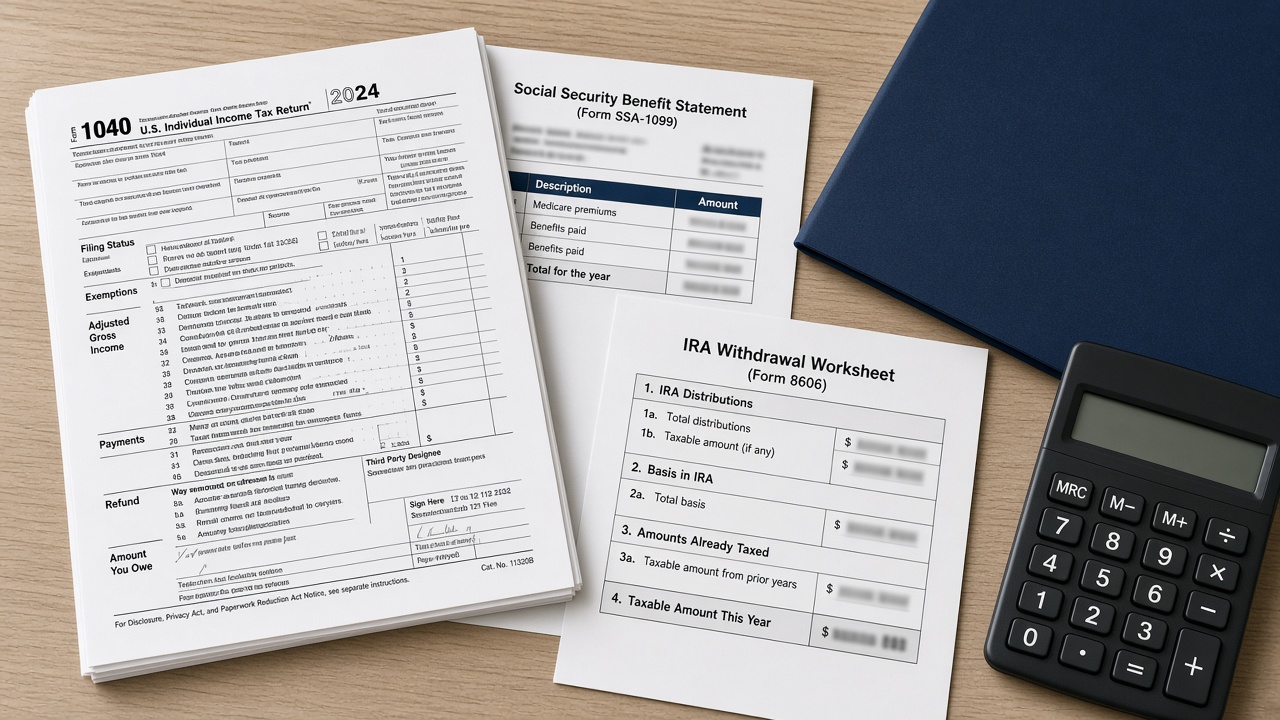
Florida does not tax retirement income. The federal return still can. Social Security, a pension, and a traditional IRA withdrawal can land on the same Form 1040. That stack is why the tax stays high after the paycheck stops.
This is the federal math, not a Florida loophole. How much of Social Security is taxable is a combined-income formula. A Roth conversion in the same year is a separate decision, and it can raise Medicare IRMAA two years later.
What still shows up on the federal return
- Up to 85% of Social Security. Combined income is adjusted gross income, not counting Social Security, plus tax-exempt interest, plus half of the benefit. Over $34,000 single or $44,000 joint, up to 85% of the benefit can be taxable.
- A pension. Most pensions are ordinary income. Florida does not add a state tax. The IRS still counts the pension.
- Traditional IRA and 401(k) withdrawals. Pre-tax money comes out as ordinary income. A Roth withdrawal of qualified money does not.
- Required minimum distributions. They generally start at age 73. The IRS requires the withdrawal. You owe tax on it whether or not you spend it.
- A Roth conversion. The amount you convert is income in that year. It can be useful in a low-income year. It is not free.
How the three lines stack
Pull three numbers before you guess at the bill.
- The benefit. The annual Social Security amount, then half of it. Half is what enters combined income. Up to 85% of the full benefit can end up taxable once combined income is high enough.
- The pension. Most private pensions are ordinary income. A government pension can have its own rule. The statement shows which one you have.
- The IRA or 401(k) withdrawal. Pre-tax money is ordinary income. A qualified Roth withdrawal is not. Required minimum distributions generally start at age 73, and the custodian will pay them even if you already spent other cash.
Add those three. Then add tax-exempt interest if you hold municipal bonds. That interest can stay off the taxable line and still raise combined income. People miss it because the 1099 says “exempt.”
Florida’s role is the zero on the state return. It does not delete the federal lines.
A second year, with a conversion
These numbers are still hypothetical.
Same couple, next year. They convert $20,000 from the traditional IRA to a Roth on top of the $30,000 they withdraw to spend. Income is $20,000 higher. Combined income moves further above the $44,000 joint line. More of the Social Security benefit can be taxable in that same year.
Medicare looks back two years. A 2026 conversion can change Part B and Part D premiums in 2028. The premium change is not on the tax return you file for 2026. It shows up later. The brackets are on Roth conversion and Medicare IRMAA.
The conversion can still be the right move in a year with no pension and no Social Security yet. The mistake is doing it in the year both have started, without adding the three lines first.
A simple example
These numbers are hypothetical. They are not a tax return.
A married couple in Wesley Chapel. Social Security: $40,000. Pension: $24,000. Traditional IRA withdrawal: $30,000. Half of Social Security is $20,000. Combined income is roughly the pension, the IRA withdrawal, and half of Social Security: $24,000 + $30,000 + $20,000 = $74,000, before other adjustments.
That is over the $44,000 joint line, so up to 85% of the $40,000 benefit can be taxable. The pension and the IRA withdrawal are taxable too. Florida adds $0. The federal bill is the one they feel.
Add a $20,000 Roth conversion the same year and combined income rises again. More of the benefit can be taxable, and Medicare can look at that income two years later.
What changes the answer
- Which account pays the bills. Spending from a Roth or from a taxable account does not add ordinary income the way an IRA withdrawal does.
- The year Social Security starts. Collecting and converting in the same year stacks the benefit and the conversion.
- Age 73. The first required distribution can be the year the return jumps, even when spending did not.
- Municipal bonds. The interest can be exempt from federal tax and still count in combined income for Social Security.
The common mistake
Treating “no Florida income tax” as “retirement is tax-free.” The state line is true. The federal line is a formula. The second mistake is converting a large IRA in the same year Social Security starts, then being surprised by the tax and by Medicare two years later.
Questions to ask
- What is combined income this year, including half of Social Security?
- Which account is paying spending: taxable, traditional IRA, or Roth?
- What happens to the return in the first required-distribution year?
- If I convert this year, what happens to Social Security tax and to Medicare two years later?
When a withdrawal order helps
Ask for one when Social Security has started, or will start soon, and a traditional IRA is still untouched. The order of withdrawals is the lever. That work sits on the retirement income page.
This is education, not a tax return. Your CPA files the return.
If you want the withdrawal order mapped before the next tax year, request a retirement readiness review.
This article is written by a licensed, credentialed advisor, not an anonymous content team. Securities and advisory services are offered through BRIA Capital Group, and Mike's license, employment history, and disciplinary record are public and searchable.

Financial advisor with BRIA Capital Group, serving Tampa Bay families and business owners from Wesley Chapel, FL. More about Mike or book a consultation.
Frequently asked questions
Why are my taxes still high in retirement if I live in Florida?
Florida has no state income tax, so the state is not the bill. The federal return can still tax up to 85% of Social Security, a pension, and withdrawals from a traditional IRA or 401(k). Those pieces stack.
Does Florida tax IRA withdrawals?
No. Florida does not tax them. The federal income tax still applies to pre-tax IRA and 401(k) withdrawals.
Can a Roth conversion make the tax higher?
Yes, in the year you convert. The conversion is added to income. It can also push more of Social Security into the taxable range and raise Medicare IRMAA two years later.
When do required minimum distributions raise the bill?
Required minimum distributions generally start at age 73. The withdrawal is taxable even if you do not need the cash, and it can move a household onto the 85% Social Security side.
Keep reading
Most non-spouse heirs who inherit an IRA after 2019 must empty it by the end of the 10th year. A spouse, and a few other heirs, can use a different rule.
Annuity fees include an M&E charge, a rider fee, fund expenses, and a surrender charge. Add them in dollars before you keep or replace the contract.